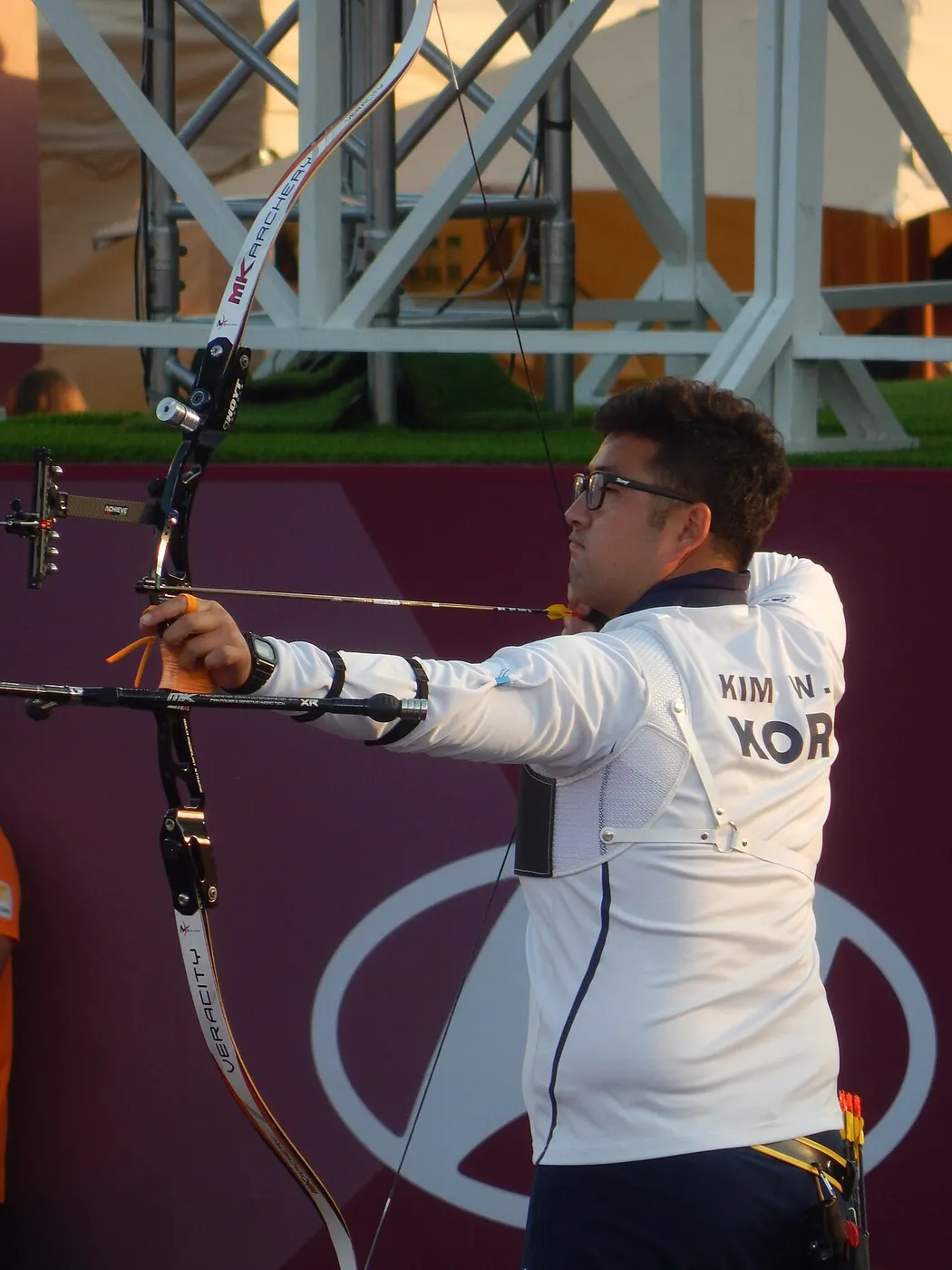
South Korean archer Kim Woojin is a prominent men's recurve competitor. Shots can look almost identical to spectators, yet small changes in stance, draw, anchor and release can alter the arrow's impact. His performances are a useful introduction to the relationship between a repeatable action and competitive pressure, rather than the idea that accuracy simply comes from aiming longer.
Three Paris titles
Kim won men's individual, men's team and mixed-team gold at Paris 2024. These events share recurve technique but organise the contest differently. Individual matchplay requires an athlete to respond independently to the set score; team formats add changes between athletes and management of a shared time allowance. The achievements belong within those distinct tasks.
Consistency is active control
A repeatable shot does not require the athlete to become mechanically rigid. Continued control at full draw, stable aiming and movement through the release all affect the outcome. Watch whether Kim's rhythm changes after the previous arrow, rather than concentrating only on the number announced when the new arrow reaches the target.
Recover for the next set
The set system gives an athlete a fresh opportunity after losing a set, making short-term recovery important. The completed arrow cannot be changed, while the next execution still can. Consider technique and match management together, and avoid assuming that a calm-looking expression provides a reliable account of what the athlete is feeling.