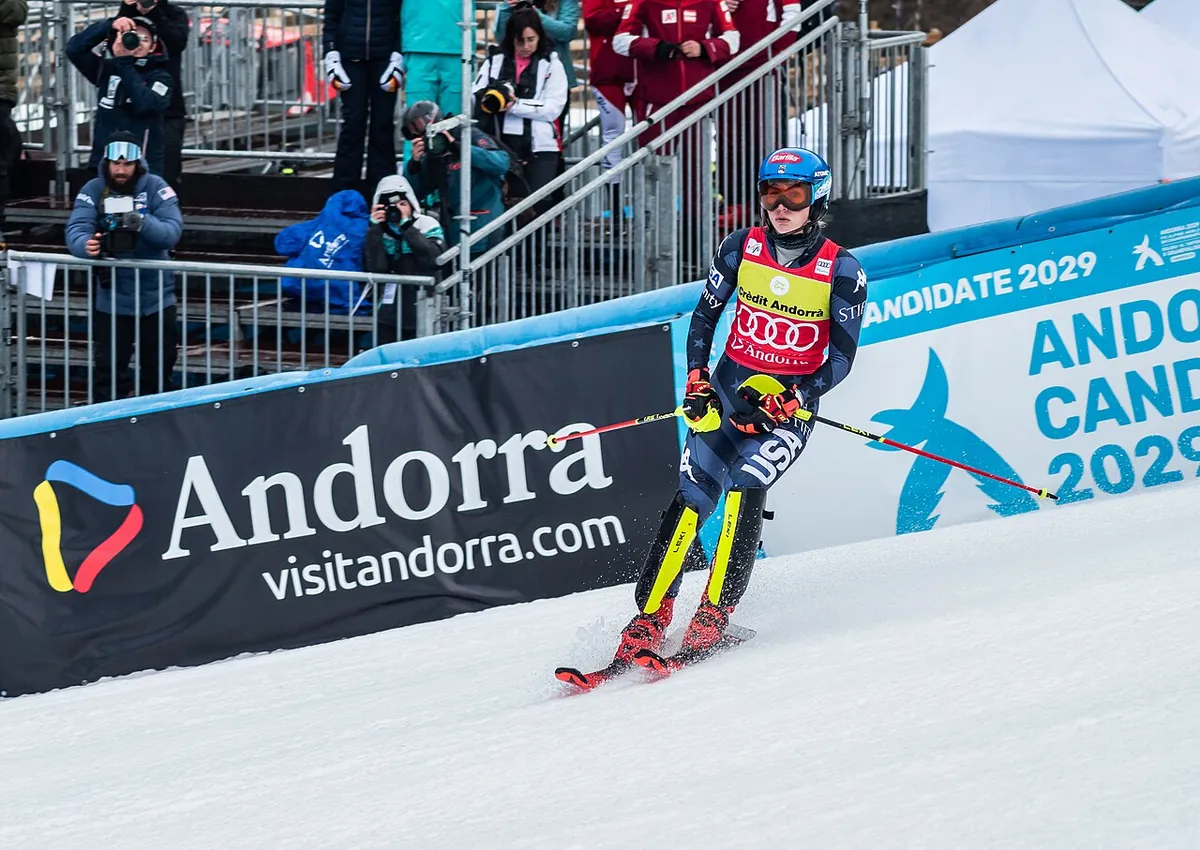
Slalom is one of alpine skiing's most tightly turning disciplines. Racers appear to knock poles aside, but their task is to follow a legal line through each gate while linking the movements efficiently. Under FIS rules, touching a pole is not itself a mistake; correct passage depends on the required movement of the skis and feet through the gate.
Preparation happens between gates
The eye is easily drawn to the moment a racer contacts a pole. However, preparation for the next turn usually begins earlier. The skier releases pressure from the previous turn, transfers balance and establishes support on the new outside ski. Late preparation can force an abrupt movement at the gate and compromise the line.
Shortest is not always fastest
Passing very close to a gate can leave insufficient space to finish the turn properly. The following correction may then cost more time than a slightly wider but better organised approach. Compare where different racers begin turning above the same gate, and whether their chosen line allows the next movement to develop naturally.
Reading the second run
Slalom commonly combines two run times, so the second run is also a contest shaped by the first-run deficit or advantage. Red and green split graphics need a clear reference point. Making up time in one section does not necessarily mean the racer now leads the entire run or the overall competition.