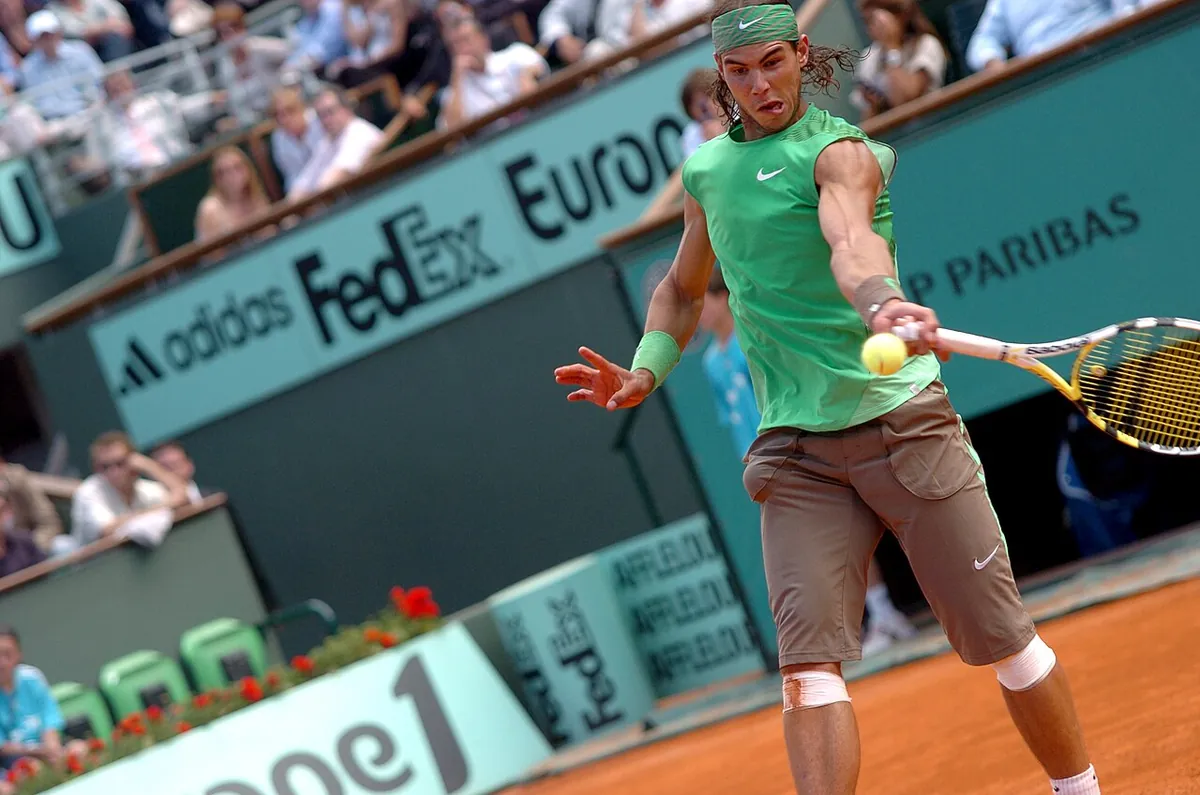
Rafael Nadal won fourteen Roland Garros singles titles between 2005 and 2022. His success on clay cannot be explained by fitness or determination alone. Spin, direction, depth and recovery form a technical system that applies sustained pressure while preserving opportunities to turn a neutral exchange into an attack.
Topspin changes the contact height
Strong topspin can provide clearance over the net before a higher bounce after landing. That bounce may make a right-handed opponent's backhand harder to handle, giving Nadal's left-handed forehand a distinctive directional effect. The benefit still depends on depth and placement; generating rotation alone does not guarantee an effective shot.
Movement prepares the following stroke
Clay permits sliding but requires control of deceleration and the next start. Reaching the ball is only part of the task: arriving in a position that supports a useful stroke is better. Watch Nadal's first recovery step after contact to see how defensive movement preserves the possibility of attacking later.
Patience can be an active strategy
Repeatedly playing into one area may build a positional advantage and draw a shorter reply. A change of direction or forward move can then exploit it. Treat the rally as a developing sequence, rather than assuming that every long exchange is passive defence or merely a contest over who tires first.