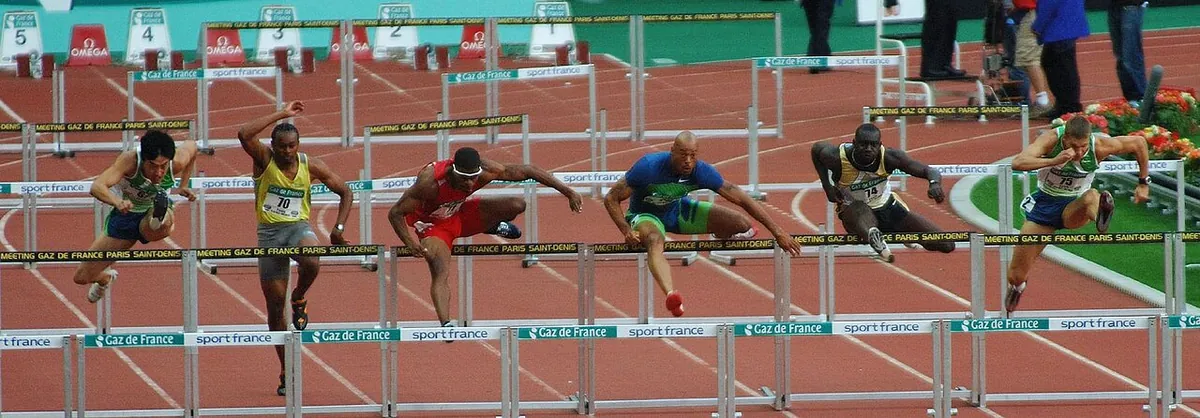
Hurdles are positioned at regulated heights and intervals. The men's 110m hurdles, women's 100m hurdles and 400m hurdles impose different demands on acceleration, stride organisation and fatigue management. Identify the event first, then treat each clearance as part of continuous forward running.
The rhythm between barriers
Efficient clearance limits the disruption to horizontal speed. The take-off position affects landing and the first step afterwards, which in turn influences the approach to the next hurdle. A small hesitation can therefore carry forward. Look for interrupted strides or excessive vertical movement rather than judging performance only by how many barriers fall.
The longer event and legal boundaries
The 400m hurdles includes bends and a full lap of effort, so athletes may change their stride pattern as conditions change. Knocking down a hurdle does not automatically invalidate a performance. Officials distinguish ordinary contact from illegal clearance, lane violations or interference, using the relevant rules and the actual action.
Look at the first step after landing
The most revealing moment may come immediately after the hurdle. A clearance that looks dramatic is not necessarily efficient if running rhythm is lost. Watch whether the athlete returns smoothly to the next sequence of strides. Compare performances within the same event; short-hurdle habits cannot simply be transferred to the 400m hurdles.